Rental Scam Self-Check: 5 Minutes with AI Before You Wire a Deposit
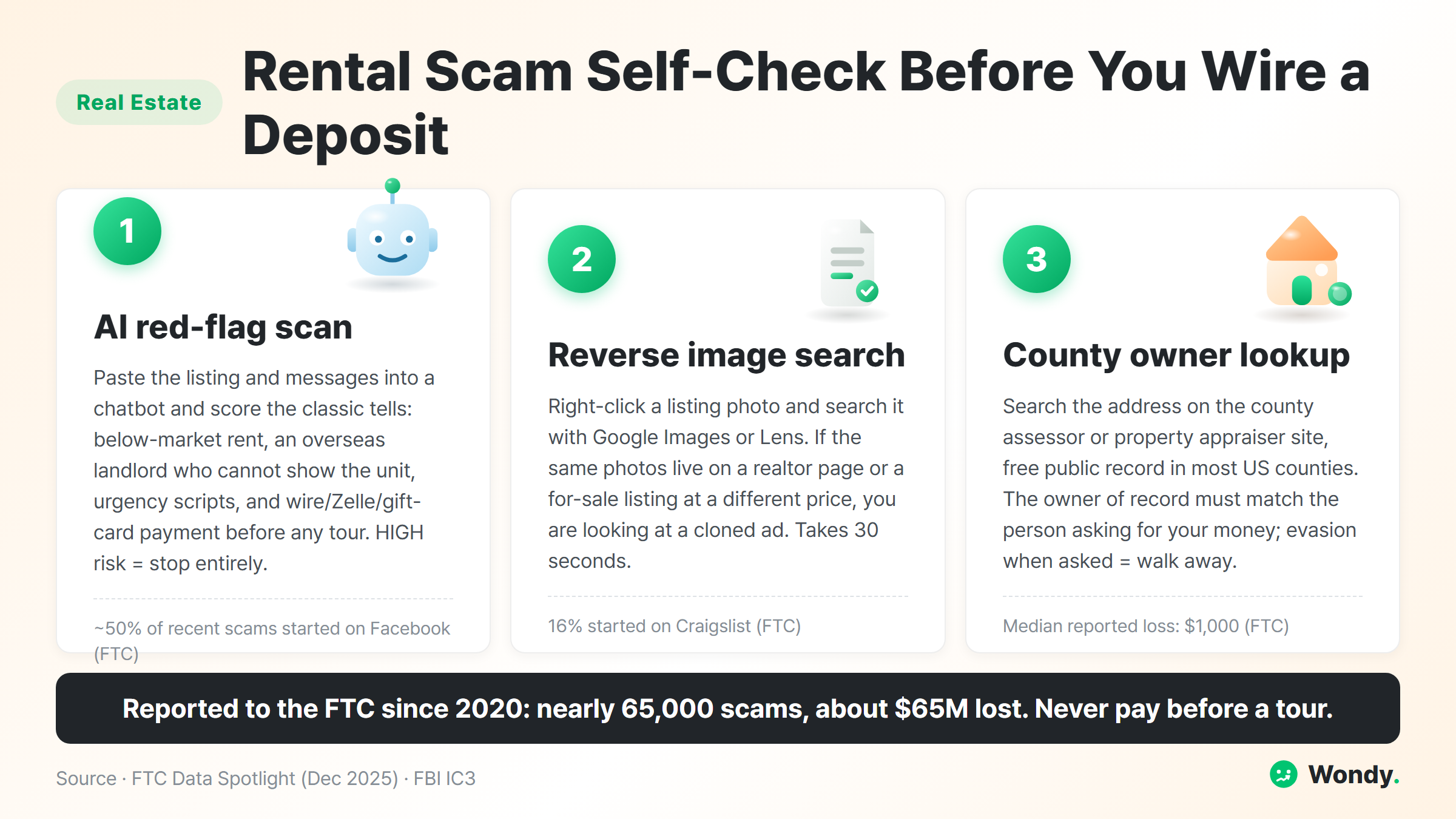
Renters have reported about $65 million in losses to rental scams since 2020, with a median hit of $1,000, and half of recent cases started with a fake Facebook listing. Before you send a deposit, run the listing through a three-part check: paste it into AI for red-flag scoring, reverse-search the photos, and verify the owner in county records. Takes five minutes, costs nothing.
The listing looks perfect: right neighborhood, updated kitchen, and rent a couple hundred dollars under everything comparable. The landlord replies fast, is very friendly, and unfortunately just relocated overseas, but if you send first month plus deposit today they will mail the keys. That story, more or less verbatim, is behind a meaningful share of the 65,000 rental scam reports the FTC has logged since 2020. The losses are not abstract: median $1,000 per victim, right when moving costs are already stacked. The pattern is so repetitive that a chatbot catches it cold, which is exactly what we are going to use.
How the scam actually works
Almost every version is the same machine with different paint. A scammer copies a real listing, photos and all, from Zillow or a realtor site, reposts it on Facebook Marketplace or Craigslist at a below-market price, and swaps in their own contact info. The FTC found that in the 12 months ending June 2025, about half of reported scams began with a fake Facebook ad and another 16% on Craigslist. The "landlord" always has a reason they cannot show the unit, and always needs money before you can see it, by wire transfer, Zelle, gift cards, or crypto. Those channels share one property: once sent, the money is effectively gone. Scale-wise, the FBI's internet crime data logged around $275 million in reported rental fraud losses, and both agencies agree the true number is larger because most victims never file.
One more uncomfortable stat: people aged 18 to 29 were three times more likely than other adults to report losing money to these scams. First-time renters, tight timelines, unfamiliar market. If that is you or your kid, this checklist earns its five minutes.
The three-part self-check
- 01AI red-flag scan
Paste listing + messages, score the tells
- 02Reverse image search
Do the photos live on another listing?
- 03Owner lookup
County assessor: does the name match?
Step 1, AI scan: covered in the next section, with the exact prompt.
Step 2, reverse image search: right-click a listing photo, search it with Google Images or Lens. If the same photos appear on a realtor's page at a different price, or on a for-sale listing, you are looking at a cloned ad. Thirty seconds, catches an enormous share of fakes.
Step 3, owner verification: county assessor and property appraiser sites are free public records in most of the US. Search the address, read the owner's name, and compare it to the person asking for your money. A legitimate landlord can prove they are the owner or the owner's documented manager. A scammer cannot, and gets hostile or evasive when asked.
- Shows the unit, or a local agent does
- Name matches county records
- Takes check or traceable payment, after a lease
- Cannot show unit, is "overseas"
- Dodges ownership proof
- Wants wire/Zelle/gift cards today
I ran this myself: the AI red-flag scan
Copy the entire listing text, plus your message thread with the landlord if you have one, into ChatGPT or Claude with this prompt:
You are a rental scam screener. Below is a rental listing and my
conversation with the person offering it. Score it against the
standard red flags the FTC warns about.

[paste listing text and messages here]

Check each of these and mark FOUND / NOT FOUND / UNCLEAR with a quote:
1. Rent significantly below comparable market listings
2. Landlord unavailable to show the unit (overseas, deployed, etc.)
3. Payment requested before an in-person or live-video tour
4. Payment method: wire transfer, Zelle/Venmo, gift cards, or crypto
5. Pressure and urgency ("others are interested, pay today")
6. Refusal or evasion when asked for ownership proof
7. Stock-photo feel or watermark artifacts in images

Then give a verdict: LOW / ELEVATED / HIGH risk, with the two
strongest reasons. Do not soften it. If information is missing,
say what I should ask the landlord next.
I fed it a listing built from the classic script, the below-market unit with the overseas owner who wanted a Zelle deposit "to hold it." The verdict came back in seconds:
Red-flag scan:
- Below-market rent: FOUND ("1,700+ the listing itself calls "typical for this street")
- Cannot show unit: FOUND ("currently doing mission work abroad")
- Payment before tour: FOUND ("deposit holds the apartment, keys shipped after")
- Untraceable method: FOUND (Zelle requested)
- Urgency: FOUND ("two other applicants ready today")
- Ownership proof: UNCLEAR (never addressed)
- Photo artifacts: NOT FOUND
Verdict: HIGH risk. Payment demanded before any viewing plus an untraceable channel is the defining combination of rental fraud. Next step if you doubt this: ask for the owner's name to match against county records; expect evasion.
Five of seven flags on a listing that, at first read, just looked like a good deal. That is the value of the checklist format: it forces the pattern into view one line at a time, with quotes, instead of letting the friendly tone carry the decision. My rule after running this dozens of times: the AI verdict is the triage, not the trial. LOW risk does not mean safe, it means proceed to steps 2 and 3. HIGH risk means stop entirely, no matter how good the kitchen looks.
If you already sent money
Speed matters more than embarrassment. Contact your bank or the payment app immediately and ask to reverse or freeze the transfer; wire recalls occasionally succeed if caught within hours. Report to the FTC at reportfraud.ftc.gov and the FBI at ic3.gov, and flag the listing on the platform so the ad comes down before the next renter finds it. None of this guarantees recovery, and that asymmetry is the whole argument for the five minutes of checking up front.
FAQ
How can I tell if a rental listing is a scam?
The classic tells: rent noticeably below comparables, a landlord who cannot show the unit, payment demanded before any tour, and untraceable payment methods (wire, Zelle, gift cards, crypto). Any one is a caution; no-tour plus untraceable payment together is close to a guarantee.
How much money do people lose to rental scams?
The FTC logged nearly 65,000 reports since 2020 with about 1,000 per victim. The FBI's 2025 internet crime report counted over $275 million lost to real estate fraud as a whole, a category that includes rental scams alongside timeshare and investment schemes, and both agencies note most cases go unreported. Adults 18 to 29 were three times more likely to report losing money.
Can AI detect a fake rental listing?
It is a strong triage tool: paste the listing and messages and it scores the standard red flags, below-market pricing, urgency scripts, payment tells. It cannot verify ownership, so pair it with a county assessor lookup and a reverse image search.
How do I verify who actually owns a rental property?
Search the address on the county assessor or property appraiser site, free public record in most counties, and match the owner name to the person asking for money. If they refuse to prove they are the owner of record, stop.
Disclaimer
This article is general consumer information, not legal advice. A clean self-check reduces risk but cannot guarantee a listing is legitimate, and scam scripts evolve. For losses or active fraud, contact your bank, reportfraud.ftc.gov, and ic3.gov. Statistics are as reported by the FTC and FBI as of July 13, 2026.
Sources
- FTC Data Spotlight, "Rental scams hit home with $65 million in reported losses" (Dec 2025): https://www.ftc.gov/news-events/data-visualizations/data-spotlight/2025/12/rental-scams-hit-home-65-million-reported-losses
- FTC press release, "FTC Analysis shows Consumers Have Lost Millions to Rental Scams": https://www.ftc.gov/news-events/news/press-releases/2025/12/ftc-analysis-shows-consumers-have-lost-millions-rental-scams
- FTC Consumer Advice, "Rental and Housing Scams": https://consumer.ftc.gov/all-scams/rental-housing-scams
- FBI IC3 2025 Annual Report (real estate fraud: $275M+, 12,368 victims): https://www.ic3.gov/AnnualReport/Reports/2025_IC3Report.pdf
- FBI Internet Crime Complaint Center (reporting): https://www.ic3.gov