Is Your Property Tax Too High? How to Appeal With AI
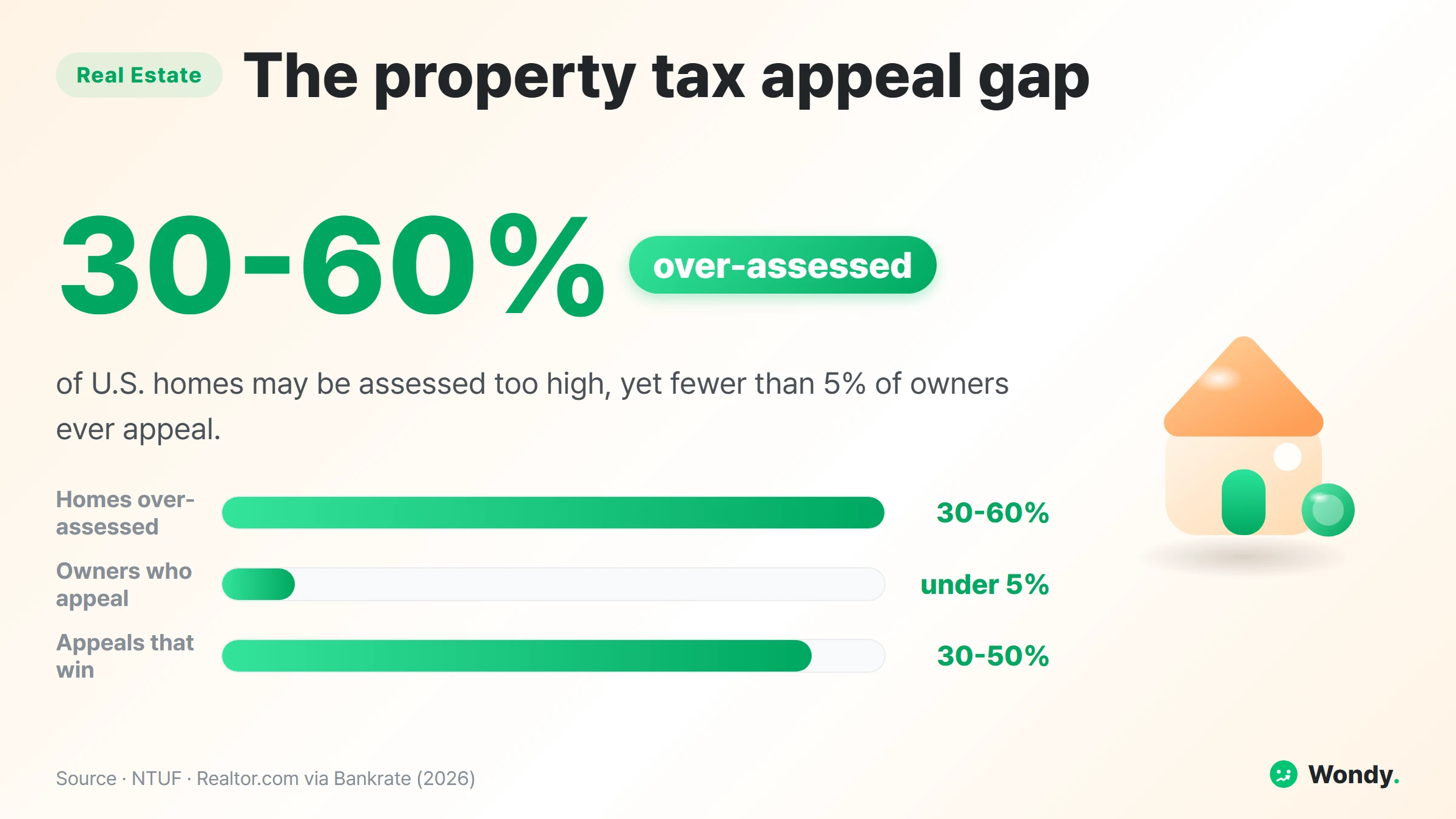
Between 30% and 60% of U.S. homes may be over-assessed, yet fewer than 5% of owners ever appeal. Your bill is your assessed value times a local rate, and the assessment is where errors hide. Here is how to check whether yours is inflated, decide if an appeal is worth it, and let AI build the comps and the dollar math for you.
Between 30% and 60% of U.S. homes are assessed for more than they are worth, according to the National Taxpayers Union Foundation. Fewer than 5% of owners ever challenge it. Put those two numbers next to each other and the takeaway is uncomfortable: a lot of people are paying a tax on a value their house does not have, every single year, because filling out one form feels like more trouble than it is worth.
Here is the thing most owners miss. You cannot argue with the tax rate. That is set by your city, county, and school district, and it is the same for your whole neighborhood. What you can argue with is the assessed value, the assessor's guess at what your home is worth. If that guess is too high, the fix is not complicated. It is a comparison, and a comparison is exactly the kind of grunt work AI is good at.
Two quick definitions before we start. Your assessed value is the dollar figure the assessor assigns to your home for tax purposes. A comp is a comparable home, one similar to yours that sold recently nearby. The whole appeal comes down to lining up your assessed value against what comps say your home is really worth.
First, check whether you are actually over-assessed
You do not appeal because your bill went up. You appeal because your assessed value is higher than what comparable homes actually sell for. Those are different things, and mixing them up is why a lot of appeals fail.
Start with the easy wins. Pull up your property record on the assessor's site and read it like a stranger would. Wrong square footage, a bathroom you do not have, a finished basement that is not finished, the wrong lot size. These factual errors are the strongest appeals because they are not opinions. You are not arguing about value, you are pointing at a typo that costs you money.
Then do the comparison that matters. Find three or four homes near you that sold in the last year and are similar in size, age, and condition. Divide each sale price by its square footage to get a price per square foot, and do the same for your assessed value. If your assessment runs well above what comps sold for per square foot, you have a case. If it lands right in the middle of them, you probably do not, and it is better to know that before you spend a weekend on it.
- Assessment clearly above recent comps
- A factual error on your record
- Gap is worth a few hundred a year
- Assessment matches nearby sales
- You just bought near the assessed price
- Gap is tiny, deadline already passed
The math on what it is worth
Run the dollars before you decide. Say your home is assessed at 5,400 a year. Now suppose your comps say the home is really worth about 4,800. You are overpaying close to $600 a year, and you keep overpaying until you fix it.
That is the shape of the decision. A Realtor.com analysis found that over 40% of properties could save at least 539. If your gap looks like the 40, spend your afternoon elsewhere.
Wondy tried it: let AI build the case
The tedious part of an appeal is the comps table and the arithmetic. That is exactly what to hand to AI. The routine is short.
- 01Gather the numbers
Your assessed value, square footage, and 3-4 recent nearby sale prices
- 02Ask AI to compare
Have it compute price per square foot and flag if you look high
- 03Check the deadline
Confirm the filing window and forms on the assessor site
Paste this into ChatGPT or Claude and swap in your own numbers inside the brackets.
You are helping me decide whether to appeal my property tax assessment.
Use only the numbers I give you and show your work.

- My assessed value: [$450,000]
- My home size: [2,000 sq ft]
- My local effective tax rate: [1.2%]
- Recent comparable sales nearby:
  - [$395,000, 1,950 sq ft]
  - [$410,000, 2,050 sq ft]
  - [$400,000, 2,000 sq ft]

Do the following:
1. Price per square foot for each comp, and the average.
2. My assessed price per square foot, and how it compares to that average.
3. An implied fair market value for my home from the comps.
4. My current annual tax vs. a fair tax at that value, and the yearly overpayment.
5. One sentence on whether an appeal looks worth the effort.

End with a caution: this is an estimate; deadlines, rules, and burden of proof
vary by county and I should confirm on the assessor's website.
With Wondy's example (assessed 400,000), here is the kind of answer that comes back.
1. Comp price per sq ft: 200.00, 200.85/sq ft**.
2. Your assessed price per sq ft: 225/sq ft**, roughly 12% above the comp average.
3. Implied fair value: 2,000 sq ft × 401,700**.
4. Tax math: current 5,400/yr**. Fair 4,820/yr**. Overpayment about $580/yr.
5. The assessment sits clearly above your comps and the yearly gap is meaningful, so an appeal looks worth the effort.
Caution: this is an estimate. Deadlines, assessment ratios, and burden of proof vary by county; confirm the rules and filing window on your assessor's website.
One habit worth keeping: check that the AI actually used your comps and not made-up ones. Ask it to list the per-square-foot number for each sale you gave it. If those match what you typed, the fair-value estimate is standing on your data, not on a guess. That one look is what separates a number you can bring to a hearing from a number that falls apart the moment someone asks where it came from.
Where this estimate can break
The AI's $580 is a starting point, not the ruling. A few things move it.
Comps are a judgment call. A home that sold after a full renovation is not a fair comp for yours if yours is original, and a distressed or family sale can drag the average down in a way an assessor will discount. Pick comps that genuinely look like your house, or the whole estimate tilts.
Rates and ratios are local. Some counties assess at a fraction of market value before applying the rate, so a raw "assessed value" is not always the same thing as market value. And in about 80% of jurisdictions the burden is on you to prove the assessment is wrong, which is a higher bar than it sounds. Read your assessment notice for how value is defined where you live.
The numbers here are as of July 14, 2026, and the over-assessment and savings figures come from the National Taxpayers Union Foundation and Realtor.com. Use this to understand the shape of your own case, then confirm the deadline, the forms, and the final decision with your county assessor.
FAQ
How is my property tax bill actually calculated?
Your bill is your assessed value times the local tax rate set by your city, county, and school district. Many places assess at a fraction of market value before applying the rate. The assessed value is the one number you can challenge. If the assessor thinks your home is worth more than it really is, you overpay every year until you correct it.
What share of homes are over-assessed, and how many owners appeal?
The National Taxpayers Union Foundation estimates 30% to 60% of U.S. homes are assessed too high, but only about 3% to 5% of owners appeal. Of those who do, roughly 30% to 50% win some reduction. The odds are reasonable; most people just never try.
Is it worth appealing my property taxes?
It depends on the gap and the effort. If recent comps suggest your home is worth clearly less than its assessed value, an appeal can pay off. Realtor.com found over 40% of properties could save at least 539. Weigh that against the hours to gather comps and file.
Can AI help me appeal my property taxes?
Yes, for the math and organization. Paste your assessed value, square footage, and recent nearby sales into ChatGPT or Claude and have it compute per-square-foot assessment, flag whether you look high, and estimate the dollars at stake. AI cannot file for you or know your county's exact rules, so confirm deadlines and forms on the assessor's website.
Disclaimer
This article is an educational walkthrough, not tax or legal advice. Assessment methods, appeal deadlines, and burden of proof vary by state and county. It does not guarantee any reduction. Confirm your specific rules, forms, and deadlines with your county assessor before acting. All figures are as of July 14, 2026.
Korea's property tax works differently, with a public assessed price and a fair-market-value ratio instead of an appeal. If you are reading in Korean, the walkthrough is here: 재산세 왜 이렇게 많이 나왔지? AI로 검산하는 법.
Sources
- National Taxpayers Union Foundation, over-assessment and appeal rates (via Bankrate): https://www.bankrate.com/personal-finance/tips-to-win-property-tax-appeal/
- Realtor.com analysis of potential appeal savings (via Bankrate): https://www.bankrate.com/personal-finance/tips-to-win-property-tax-appeal/
- How to Appeal Your Property Tax Assessment, PropertyTaxRates.org: https://propertytaxrates.org/blog/how-to-appeal-property-tax-assessment-guide